

No 41
This is, as far as I can see, the only fully detached house in Castle street.
I like this building! It has nice proportions and is constructed with quality.
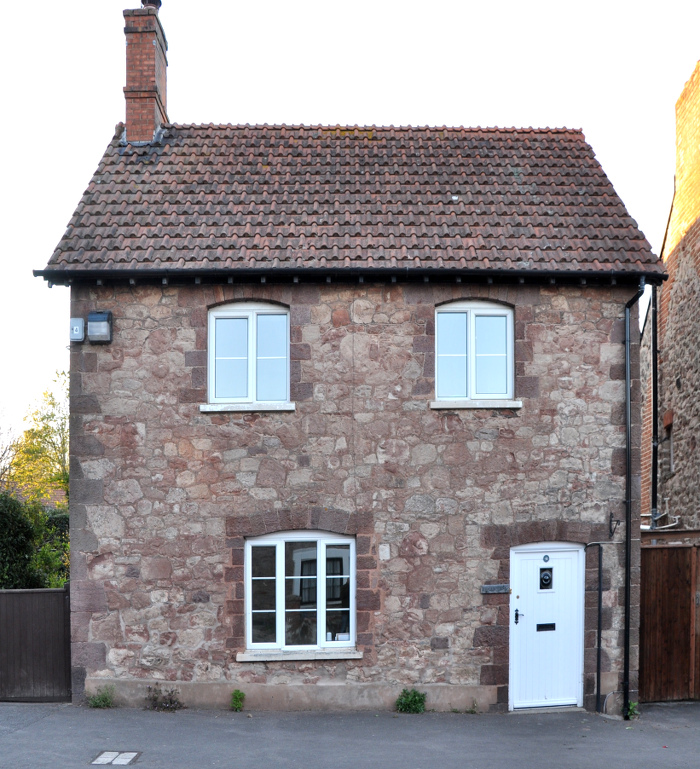
No.41

The stone work is of high quality, although the stone is laid random rather than coursed, the individual stones are large and yet have tight joints. This shows the quality of building skill used - most random stonework was of smaller stones and had broader jointing, mainly because they were usually then rendered; only later was render removed and new pointing used.
The rough-dressed quoins have a nice contrast in colour and the low arched lintels complete what I think is an attractive building. The roof tiles are unusual, similar to double roman style, but modified to allow for staggered horizontal coursing, whereas normal double roman tiles are laid with straight vertical joints. Also the rafter ends are exposed, which again is unusual for Castle street.
Looking back at early maps, it appears that an earlier building here was larger than the current one. It appears to be double fronted. Both the 1750 illustrative map and the 1840 tithe map show this larger building. But by the 1880 map, this building shows as it is now, which obviously suggests the old building was demolished and the current building was built between 1840 and 1880. Or possibly there were originally two adjoining buildings that were replaced by just the one?

1750 map illustration


1840 tithe map (left) 1880 map (right)
Because the building is set back from the building line of the rest of Castle street, it is partly hidden from the east side. The only photos showing this from higher up castle street only really show the western gable wall. There has not really been much change other than the present first floor window in the gable wall, which I think was only installed after 2000.


1947 photo (left) 1912 photo (right)
....
This page is still under review, please come back to see future additions.
....