

Description of Castle Street
For those who do not know this street, here is a general description,
and a few general observations about Castle Street and its buildings.

Castle Street, north side, eastern section
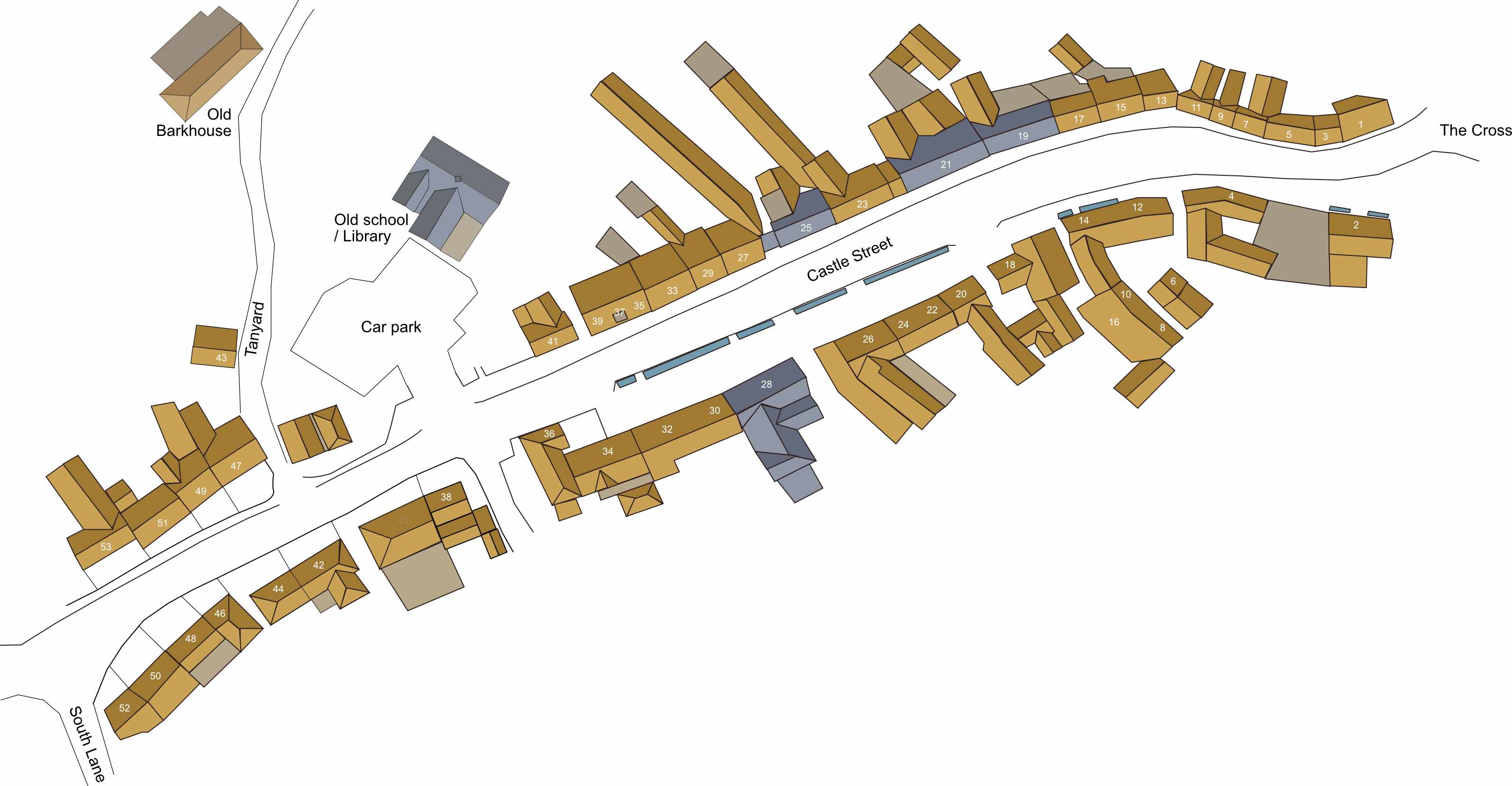
Castle Street is a street of two parts… approximately two thirds and
one third...
Entering the street from the cross at the centre of village (eastern end), there is an initial slight bend before it opens up to show the main section, which is very broad with the buildings on one side set away from the opposing side.
Entering the street from the cross at the centre of village (eastern end), there is an initial slight bend before it opens up to show the main section, which is very broad with the buildings on one side set away from the opposing side.

Eastern section, looking east back towards centre of village, showing the open aspect
There is a wide pavement on the north side, then the main roadway,
beside which is a brook running down the south side of the road with
a broad area between that and the buildings on the south side.
At the top end of this 'lower' section, the street is visually closed down to a narrowing by a house set at right angles to the other buildings. This is also where the brook enters the street, coming underground from the north and into a channel that runs down beside the road and into St Mary street. There are various places where the brook is piped under the pavement or access bridges.
The whole of this lower section has a gentle rise towards the west, but from this point, although the road itself does not climb much more, the land to the south starts to rise more steeply, which has made the 'upper' Castle street quite different in character.
The upper section of Castle Street runs from the car park up to the junction with South Lane.
Although, on this upper section the buildings are still approximately the same distance apart from one side to the other, each building has private enclosed space in front of it which effectively closes the street back to the actual road width, with just a footpath on the north side, giving it a quite different character to the lower, main section.
At the top end of this 'lower' section, the street is visually closed down to a narrowing by a house set at right angles to the other buildings. This is also where the brook enters the street, coming underground from the north and into a channel that runs down beside the road and into St Mary street. There are various places where the brook is piped under the pavement or access bridges.
The whole of this lower section has a gentle rise towards the west, but from this point, although the road itself does not climb much more, the land to the south starts to rise more steeply, which has made the 'upper' Castle street quite different in character.
The upper section of Castle Street runs from the car park up to the junction with South Lane.
Although, on this upper section the buildings are still approximately the same distance apart from one side to the other, each building has private enclosed space in front of it which effectively closes the street back to the actual road width, with just a footpath on the north side, giving it a quite different character to the lower, main section.

Western section, looking west towards South Lane, showing the more enclosed aspect
As mentioned, the difference with the top third section is that the
ground rises to the south from the car park up towards South Lane,
so those buildings on the south side have their ground levels
gradually rising above the road level, resulting in the buildings
having several steps up the the front door. Because of these
variations there is a marked difference in general appearance
between the two main sections of Castle Street.
Beyond Castle Street, the ground starts to rise much more steeply as it climbs towards the Mount, and becomes Castle Hill.
So, for the purpose of my project, I am defining the change from Castle Street to Castle Hill to be at the junction with South Lane.
I realise that some consider that, technically, Castle street continues further up the hill. However, I consider that the change in character above South lane, not to mention the sharp change in incline, makes it the start of Castle Hill; especially as the north side is dominated by the large house known as 'Castle Hill House', which is actually hidden behind a tall stone wall, so effectively not on the street at all.
I apologise if anyone is troubled by my definition of the transition of Castle Street into Castle Hill, but as this is my personal project - I'm afraid they will have to put up with it!
How has Castle street changed over the years?
Here are a couple of comparison photos showing how things have changed in the recent past.
drag or tap/click to move divider and show 'then' and 'now' image
- Eastern 'lower' section, Castle Street, looking west -
Then: postcard, approx 1900-1910, showing how broad the street is;
Now: the same view showing today's congestion
Then:- Western 'upper' section, Castle Street, looking east, maybe around 1900
Now: the same view showing today's version
Beyond Castle Street, the ground starts to rise much more steeply as it climbs towards the Mount, and becomes Castle Hill.
So, for the purpose of my project, I am defining the change from Castle Street to Castle Hill to be at the junction with South Lane.
I realise that some consider that, technically, Castle street continues further up the hill. However, I consider that the change in character above South lane, not to mention the sharp change in incline, makes it the start of Castle Hill; especially as the north side is dominated by the large house known as 'Castle Hill House', which is actually hidden behind a tall stone wall, so effectively not on the street at all.
I apologise if anyone is troubled by my definition of the transition of Castle Street into Castle Hill, but as this is my personal project - I'm afraid they will have to put up with it!
How has Castle street changed over the years?
Here are a couple of comparison photos showing how things have changed in the recent past.
drag or tap/click to move divider and show 'then' and 'now' image
- Eastern 'lower' section, Castle Street, looking west -
Then: postcard, approx 1900-1910, showing how broad the street is;
Now: the same view showing today's congestion
Then:- Western 'upper' section, Castle Street, looking east, maybe around 1900
Now: the same view showing today's version
Although my interest in Castle Street has come from the buildings I see here today, I can't help wondering why Stowey developed into a village here in the first place and became what it is today. So I have explored that question a little... here...
(This page is still under review and may well change, please come back to see future additions.)